
A website audit is a full health check of your website. It looks at how well your site performs for search engines, your visitors, and your business. A proper audit checks whether your website can be found, whether it loads quickly, whether people can use it easily, and whether it gives potential customers enough confidence to make an enquiry.
A good website audit does not simply produce a list of technical errors. It explains what is wrong, why it matters, and what needs to happen next. This is important because many small business websites grow over time without a clear plan. Pages get added, text gets copied in, images are uploaded without being resized, plugins are installed and forgotten, and the design slowly starts to look dated.
Over time, contact details can become harder to find, the message can become less clear, and the website can become harder to use. The site may still look acceptable at first glance, but it may be quietly holding the business back. A website audit helps you see what is working, what is not working, and what needs fixing first.
Why Does a Website Audit Matter?
Your website is often the first serious contact someone has with your business. Before they call you, book with you, visit your premises, or fill in a form, they will usually look at your website. They want to know what you do, where you work, whether you look reliable, and whether you can solve their problem.
If your website is slow, unclear, outdated, or difficult to use, people may leave before they make contact. They may not tell you why. They may simply go back to Google and choose another business. This is why a website audit matters. It helps identify the issues that stop people from trusting your business or taking the next step.
An audit can uncover problems such as slow loading pages, oversized images, unclear calls to action, weak page titles, missing contact details, poor mobile layout, confusing navigation, thin content, broken links, outdated plugins, missing analytics, and service pages that do not match what customers are actually searching for.
For some businesses, the main issue is technical. For others, the problem is content, design, structure, or trust. In many cases, it is a combination of all of these. A website may load slowly because the images are too large. It may also fail to rank because too much information has been forced onto one page. It may look professional on desktop, but be awkward to use on a mobile phone. A proper audit brings those problems into the open.
What Does a Website Audit Check?
A website audit usually reviews several parts of your website. Each part matters because Google and real visitors judge your site in different ways. A search engine needs to crawl, read, and understand your website. A visitor needs to understand your message quickly. A potential customer needs to trust you enough to make contact.
A strong audit should look at all of these areas together. It should not only ask whether the website exists online. It should ask whether the website is doing its job. That means looking at technical SEO, on page SEO, content quality, user experience, design, speed, mobile usability, security, tracking, trust signals, and conversion points.
Technical Performance
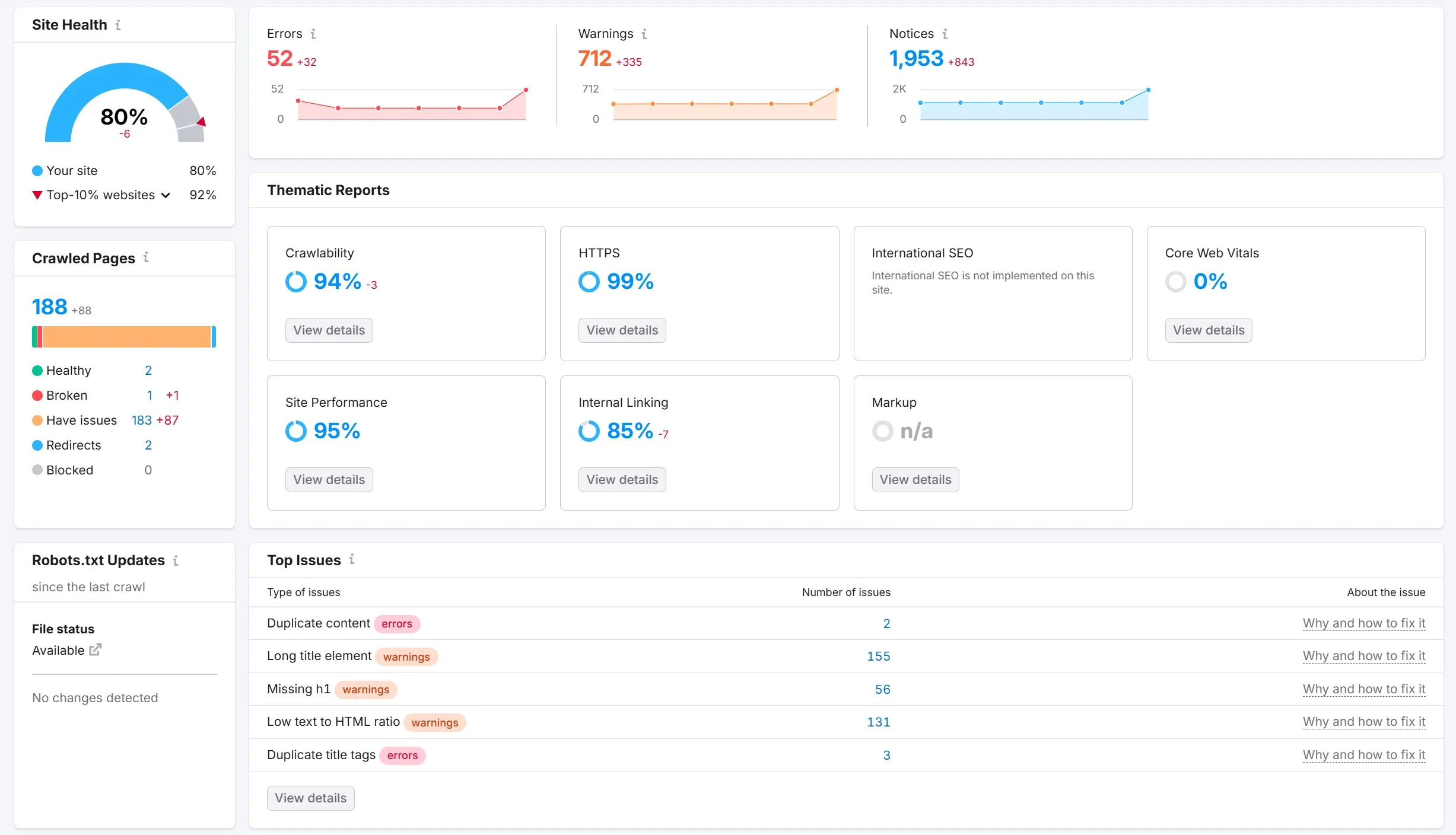
Technical SEO looks at whether search engines can access, crawl, and understand your website. If Google cannot read your site properly, it cannot rank it properly. If important pages are not indexed, they cannot appear in search results. If your site structure is confusing, Google may struggle to understand which page should rank for which search term.
A technical SEO audit checks things such as indexation, crawl errors, sitemap validity, HTTPS security, redirects, broken links, site structure, page speed, duplicate content, and whether important pages are blocked from search engines. It can also check whether Google is choosing the wrong page to rank because the website structure is unclear.
This is a common issue when a homepage is overloaded with too many services, locations, and keywords. Instead of strengthening the website, it can confuse Google. If the homepage is trying to rank for everything, the dedicated service pages may struggle to perform. A technical review helps identify these problems and gives the business a clearer route forward.
On Page SEO
On page SEO looks at how well each page is set up for search. This includes page titles, meta descriptions, headings, internal links, image alt text, keyword focus, and the quality of the written content. Each page should have a clear purpose. It should be obvious what the page is about and what search it is trying to answer.
Many small business websites struggle because they do not have enough focused pages. One page may try to cover several services, several locations, and several different customer needs. This makes the content harder for users to follow and harder for Google to understand.
A good audit checks whether each page has a clear focus. It also checks whether the page title and headings support that focus. If the title says one thing, the headings say another, and the content talks about several different services, the page may not perform well. A website audit helps untangle this and shows where pages may need to be rewritten, merged, split, or expanded.
Content Quality
A content audit looks at whether your website gives people enough useful information. Thin content is one of the most common problems on small business websites. A page may have a few short paragraphs, but it may not answer the questions a customer has before they enquire.
Good content should explain what the service is, who it is for, where it is available, what problem it solves, what makes your business a safe choice, and what the customer should do next. It should also match search intent. Someone searching for a website audit does not usually want a technical lecture. They want to know what it is, what it includes, why it matters, and whether it is worth paying for.
A website audit checks whether your content does that job. It also looks for outdated content, duplicated content, vague wording, missing details, and pages that do not give enough value. Too much text can also be a problem if it is not organised well. Long blocks of unclear content can make visitors leave. The goal is not just to add more words. The goal is to make the content clearer, more useful, and easier to act on.
User Experience and Design
User experience, often called UX, looks at how easy your website is to use. A website can rank well and still fail to generate enquiries if visitors do not know what to do next. The design may look fine, but if the navigation is confusing, the call to action is weak, or the contact details are hard to find, people may leave.
A UX and design audit reviews the layout, menu structure, buttons, forms, mobile experience, readability, page flow, and calls to action. It asks whether a visitor can quickly understand what the business does and how to take the next step.
Common issues include unclear navigation, outdated design, too much text, poor use of images, weak calls to action, missing trust signals, and pages that feel cluttered. A visitor should not have to work hard to understand your business. They should be able to see what you offer, where you work, why they should trust you, and how to contact you.
Speed and Core Web Vitals
Speed is an important part of a website audit because slow websites lose visitors. They can also affect how Google judges the quality of the page. A slow site feels frustrating, especially on mobile. If someone is searching for a service and your website takes too long to load, they may not wait.
Large images are one of the most common causes of slow loading pages. Many business owners upload photos straight from a phone or camera. These images may be far too large for the website. A 2MB image may look fine visually, but it can slow the page down, especially when several large images load on the same page.
A speed audit checks image sizes, caching, server response time, unused code, plugin load, scripts, layout shifts, and mobile performance. It may also review Core Web Vitals, which measure loading speed, responsiveness, and visual stability. The aim is not just to get a better score in a testing tool. The real aim is to make the website faster and easier for people to use.
Mobile Usability
Most people now view websites on their phones, so mobile usability is no longer optional. A website may look good on desktop but fail on mobile because the text is too small, buttons are too close together, images crop badly, or the menu is hard to use.
A mobile audit checks whether the website is easy to navigate on a smaller screen. It looks at whether the contact buttons are visible, whether forms work properly, whether the text is readable, whether images load quickly, and whether important information appears high enough on the page.
For local service businesses, mobile performance is especially important. People often search from their phone when they need help quickly. If they cannot call you easily or understand your offer within a few seconds, they may choose a competitor.
Security and Maintenance
A website audit should also check basic security and maintenance. This includes whether the SSL certificate is active, whether the website uses HTTPS, whether plugins are up to date, whether the theme is maintained, and whether there are obvious risks from outdated software.
Poor maintenance can cause performance issues, security risks, broken layouts, and form problems. A website is not something you build once and then ignore. WordPress, themes, plugins, tracking codes, forms, and privacy tools all need regular attention.
An audit helps identify whether your site has been left without proper care. It can also show whether old plugins, unused tools, or outdated features are making the website slower or less secure.
Analytics and Tracking
One of the most common problems found during audits is missing or poorly configured tracking. If analytics are not set up, you are guessing. You do not know which pages people visit, how they find you, how long they stay, or whether enquiries are being tracked correctly.
A website audit should check whether Google Analytics and Google Search Console are installed and working. It should also check whether form submissions, phone clicks, or other important actions are being measured.
Without this data, it is much harder to make good decisions. You may think one page is performing well, but the data may show that people are leaving quickly. You may think the homepage is bringing in enquiries, but Search Console may show that a service page is doing most of the work. Tracking gives you a clearer picture of what is happening.
Calls to Action and Conversion Points
A website audit should not only ask whether people can find your website. It should also ask whether people know what to do when they get there. Many websites explain the service but fail to guide the visitor towards action.
A strong website should make the next step clear. That might be to call, request a quote, book a consultation, complete a form, or send a message. The call to action should appear in the right places across the website, not just once at the bottom of a page.
An audit should check whether your calls to action are clear, visible, and relevant. It should also check whether your offer is easy to understand. Visitors need to know what you do, why they should choose you, and what happens after they enquire. If your website cannot answer those questions clearly, it may lose leads.
Trust Signals
Trust signals are a key part of a website audit because people want proof before they contact a business. A website without trust signals can feel anonymous, even if the business is experienced and reliable.
Trust signals can include reviews, case studies, certifications, accreditations, before and after examples, client results, portfolio images, guarantees, clear contact details, real photos, team information, and business address details.
A good audit checks whether your website gives people enough reasons to trust you. This is especially important for service businesses, where customers often need confidence before making contact. If your competitors show reviews, results, and clear proof of experience, and your website does not, you may be losing enquiries before people even speak to you..
Why One Page is Often Not Enough
One of the biggest issues found during website audits is too much information forced onto one page. This often happens when a business starts small and adds more services over time. Instead of building proper service pages, everything gets added to the homepage or one main services page.
This can weaken the website. It makes it harder for visitors to find what they need, and it makes it harder for Google to understand which page should rank for each topic. A clear website structure usually performs better because each important service or location has its own focused page.
This does not mean creating pages for the sake of it. It means giving each important search a useful page that answers the query properly. If your business offers several services or covers several locations, your website may need more structure than a homepage and one general service page.
Real Example: Next Generation Insulation
When reviewing the Next Generation Insulation website, one of the main issues was structure. The business covered four large cities, but the website only had five pages. This meant too much important information had been crammed onto the homepage and one service page.
The site was trying to cover too much with too little structure. From an SEO point of view, Google did not have enough clear page level content to match specific searches. From a user point of view, visitors did not have focused pages that answered their exact needs.
The audit showed that the problem was not just keyword usage. The issue was the structure of the whole website. The business needed clearer service pages, better content depth, and a stronger layout so each topic had its own place. Without that, the site struggled to rank properly.
Real Example: Heating Oil Today
Heating Oil Today had a different issue. The business was relying heavily on its Google Business Profile for leads, while the website itself had very little useful information. The design was outdated, the content was thin, and the site had very few pages.
A Google Business Profile can be powerful for a local business, but it should not carry the full weight of lead generation. The website still needs useful content, service information, location relevance, trust signals, and clear conversion points.
The audit showed that the business needed more than a few small edits. It needed stronger website structure, more helpful content, and a clearer reason for both users and search engines to trust the site. Once a website has useful pages and a clearer structure, it has a much better chance of supporting rankings and enquiries.
Are Free Website Audits Useful?
A free basic website audit can be a useful starting point. It helps a business owner see the main issues without committing to a full project straight away. It can also give them an idea of what needs doing, how long the work may take, and what sort of budget may be needed.
However, a free audit is usually only the first layer. Automated tools can flag broken links, missing meta descriptions, slow pages, and technical errors. That information is helpful, but it does not always explain the bigger picture.
A tool cannot always judge whether your message is clear. It may not know whether your website builds trust. It may not understand whether your service pages match the way real customers search. It may not spot that your whole website structure is holding back your rankings.
That is why a good audit should combine data with human review. Tools can show what is happening. Experience helps explain why it is happening and what should be done next.
What Should You Receive After a Website Audit?
After a website audit, you should not be left with a confusing list of errors. You should receive a clear explanation of the findings and a practical action plan. A professional audit should explain the issues in plain English, so you understand what is wrong and why it matters.
A useful audit should cover technical SEO, content, user experience, mobile usability, speed, security, tracking, trust signals, and conversions. It should also prioritise the work because not every issue has the same level of impact.
Some fixes are urgent because they affect indexing, speed, security, or enquiries. Other improvements can be planned over time. A good audit should show what needs fixing first, what can wait, what will help rankings, what will help conversions, what content needs improving, what pages may need adding, and what technical issues need attention.
It should also give you a realistic idea of time and budget. Many business owners know something is wrong with their website, but they do not know whether it needs a small tidy up, a content restructure, technical repairs, or a full rebuild. A website audit helps make that decision clearer.
Should a Website Audit Include Competitor Research?
Competitor research can make a website audit more useful. It helps show how your website compares with the businesses already ranking well in your market. This does not mean copying competitors. It means understanding what Google is already rewarding for the searches you care about.
Competitors may have stronger service pages, clearer location content, better FAQs, more trust signals, stronger internal links, faster pages, or more useful content. An audit can help identify the gap between your website and the websites currently performing well.
Once you understand that gap, you can build a better plan. You can see whether you need more content, clearer pages, better technical foundations, improved design, stronger proof, or a more focused SEO strategy.
Should a Website Audit Include AI Readiness?
AI readiness is becoming more important because search behaviour is changing. People now use Google, Bing, ChatGPT, Gemini, Perplexity, and other tools to research businesses, services, and buying decisions. Your website needs to be clear enough for search engines and AI systems to understand.
An AI readiness review may look at whether your content clearly explains who you are, what you do, where you work, what experience you have, and why your business can be trusted. It may also review structured data, FAQs, service pages, author information, business details, and whether your content answers real questions in a useful way.
If your website is vague, thin, or poorly structured, it becomes harder for search engines and AI tools to understand and reference your business. A website audit can help identify where your content needs more clarity, depth, and structure.
How Often Should You Audit Your Website?
Most business websites should have a proper audit at least once a year. You may need one sooner if your rankings have dropped, enquiries have slowed down, your website feels outdated, you have added new services, your location coverage has changed, your site has become slow, or no one has maintained it for a long time.
A website audit is also useful before investing in SEO. There is little point paying for ongoing SEO if the website has technical problems, weak pages, unclear messaging, poor mobile layout, or weak conversion paths. The audit helps fix the foundations first.
It is also sensible to audit your website before a redesign. This helps you understand what should be kept, improved, removed, or rebuilt. Without an audit, there is a risk of carrying old problems into the new design.
What is the Difference Between a Website Audit and an SEO Audit?
An SEO audit focuses mainly on search performance. It looks at how well your website can rank in search engines and identifies issues that may be stopping Google from understanding or ranking your pages.
A website audit is broader. It includes SEO, but it also looks at user experience, design, speed, security, content quality, tracking, trust, and conversions. This matters because a website can have decent SEO and still fail to generate enquiries. It can also look attractive but still fail because Google cannot understand it.
A full website audit gives a more complete view of performance. It looks at whether your website can be found, whether people can use it, and whether it encourages them to act.
FAQs About Website Audits
What is a website audit in simple terms?
A website audit is a full review of your website. It checks how well your site performs for search engines, visitors, and business enquiries. It helps find problems with speed, content, SEO, mobile layout, security, design, and calls to action.
Is a website audit worth it?
Yes, especially if your website is not getting enough traffic or enquiries. A website audit can show what is stopping your site from ranking, converting, or giving users a clear experience. It can also help you avoid spending money on the wrong fixes.
How long does a website audit take?
The time depends on the size of the website and the level of detail needed. A small free audit may highlight the main issues quite quickly. A full audit takes longer because it reviews technical SEO, content, user experience, speed, mobile usability, tracking, security, and competitor performance.
Can I do a website audit myself?
You can run basic checks yourself using online tools, but tools only show part of the picture. They may flag errors, but they may not explain whether your message is clear, whether your page structure makes sense, or whether your website is likely to convert visitors into enquiries.
What tools are used in a website audit?
Common tools include website crawlers, speed testing tools, Google Search Console, Google Analytics, mobile testing tools, SEO platforms, backlink tools, and security checkers. The tools provide data, but the real value comes from knowing how to interpret that data and turn it into a practical plan.
What are the most common website audit problems?
Common problems include slow loading speed, oversized images, weak page titles, poor mobile layout, unclear calls to action, thin content, missing trust signals, confusing navigation, no analytics, outdated design, poor maintenance, and too much information placed on one page.
Does a website audit help SEO?
Yes. A website audit can identify technical SEO issues, content gaps, weak metadata, indexing problems, poor internal linking, and missing service pages. These issues can stop your website ranking as well as it should.
Will a website audit improve enquiries?
An audit alone will not improve enquiries unless the recommended changes are made. However, it can show why enquiries are low and what needs to change. This may include clearer contact details, stronger calls to action, better service pages, faster loading speed, improved trust signals, and clearer page structure.
Should I get a website audit before redesigning my site?
Yes. A website audit before a redesign helps you understand what should be kept, improved, removed, or rebuilt. It can stop you from carrying old problems into the new website. It also gives the redesign a clearer strategy.
What should I do after a website audit?
After a website audit, you should work through the priority list. Start with issues that affect indexing, speed, security, mobile usability, and conversions. Then move on to content improvements, service page structure, internal links, trust signals, and longer term SEO growth.
Why a Website Audit Helps You Make Better Decisions
A website audit gives you a clear view of how your website is really performing. It helps you move away from guesswork and see what needs fixing first.
For many small businesses, the biggest problems are not always hidden technical issues. They are often simple things that have a big impact, such as unclear messaging, slow pages, weak service content, poor mobile layout, missing trust signals, and no clear call to action.
A useful audit should give you answers. It should show why your website is underperforming, what needs to change, and which steps will make the biggest difference.
Your website should not just exist online. It should help people understand your business, trust your service, and take action. A proper website audit shows whether it is doing that job.